
17 September 2026
Home Charging Explained: Everything You Need to Know About Charging an EV at Home
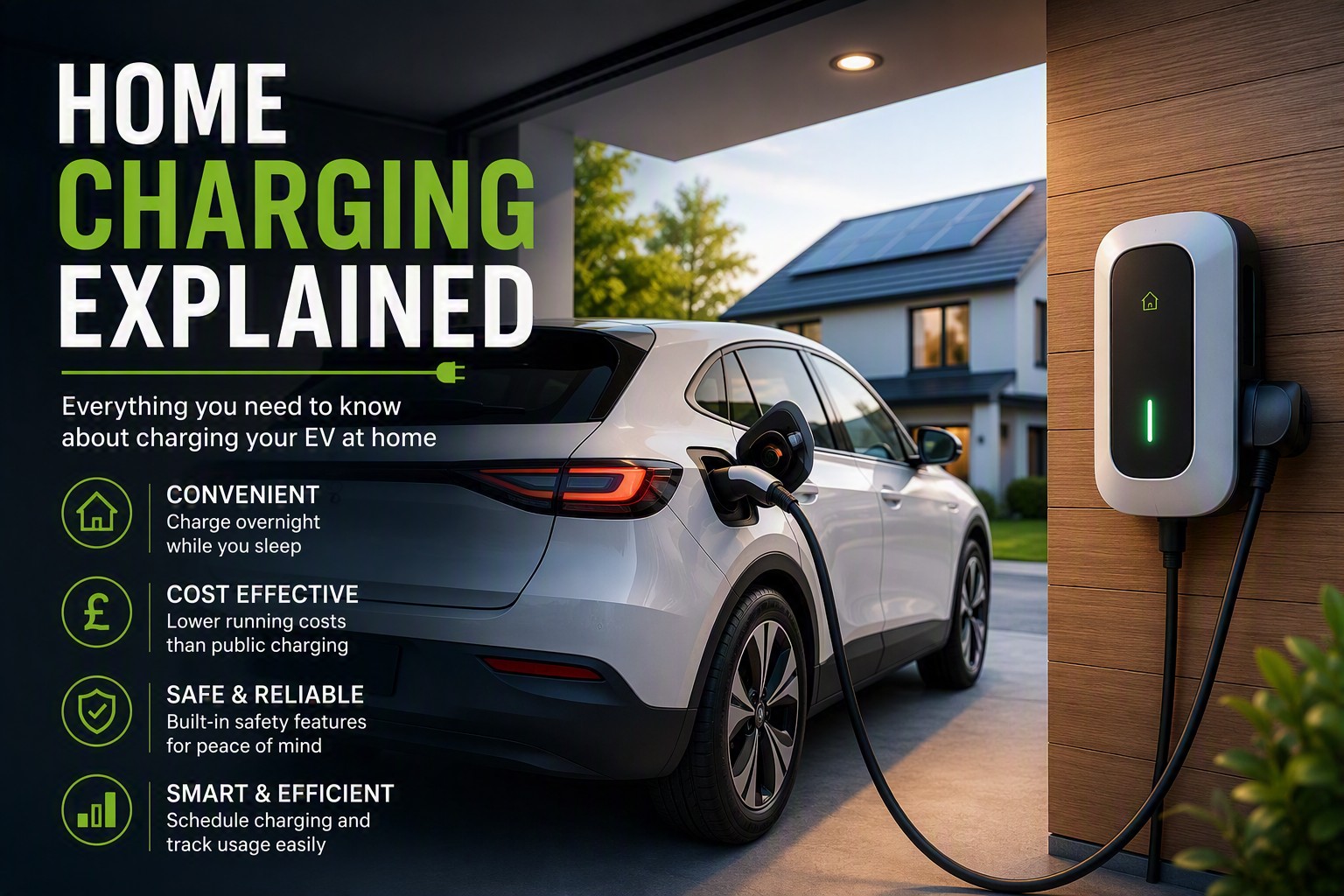
For most electric vehicle owners, home charging quickly becomes one of the biggest advantages of driving an EV. Instead of planning trips to a petrol station every week, you simply plug in when you get home and wake up to a fully charged battery the next morning.
Home charging is convenient, cost-effective, and surprisingly straightforward once you understand the basics. Whether you’re considering your first electric vehicle or looking to install a dedicated home charger, this guide explains everything you need to know.
Why Home Charging Matters
One of the most common misconceptions about EV ownership is that drivers spend lots of time waiting at public charging stations.
In reality, most EV charging takes place at home.
Think about how you currently use your car. Most vehicles spend many hours parked overnight. An electric vehicle can take advantage of this downtime by slowly replenishing its battery while you sleep. By morning, your car is ready for another day of driving.
For many drivers, this means never needing to visit a public charger during normal daily use.
How Home Charging Works
Charging an EV is fundamentally simple.
Electricity flows from your home’s electrical supply into the vehicle’s battery, where it is stored for later use.
The speed of charging depends on:
- The power available from the charger
- The vehicle’s onboard charging capability
- Battery size
- Battery charge level
- Ambient temperature
The more power available, the faster the battery replenishes.
Types of Home Charging
Three-Pin Plug Charging
The simplest method is plugging your EV into a standard household socket using a charging cable supplied by the manufacturer.
This is often called a “granny charger.”
Advantages:
- No installation required
- Uses existing household sockets
- Useful as an emergency backup
Disadvantages:
- Very slow
- Typically provides only 2.3kW
- May take over 24 hours to fully charge larger batteries
While it works, most EV owners quickly upgrade to a dedicated wall charger.
Dedicated Home Wallbox Charger
A wallbox is a purpose-built charging unit installed outside your home or in a garage.
Most UK home chargers provide:
- 7kW single-phase charging
- Smart charging functionality
- Scheduled charging
- Remote control via mobile app
Benefits include:
- Much faster charging
- Greater efficiency
- Enhanced safety
- Automatic charging schedules
- Solar integration options
For most households, a 7kW wallbox is the ideal solution.
How Long Does Charging Take?
Charging times vary depending on battery size and charger output.
Example Charging Times
| Battery Size | 2.3kW Plug Socket | 7kW Home Charger |
|---|---|---|
| 40 kWh | 17-20 hours | 5-7 hours |
| 60 kWh | 26-30 hours | 8-10 hours |
| 77 kWh | 33-38 hours | 10-12 hours |
| 100 kWh | 43-48 hours | 13-15 hours |
In reality, most drivers don’t arrive home with an empty battery.
If you’ve used only 20% of your battery during the day, a home charger may replace that energy in just a few hours.
How Much Does Home Charging Cost?
One of the biggest advantages of EV ownership is lower “fuel” costs.
The cost of charging depends on:
- Your electricity tariff
- Household energy rates
- Charging time
- Battery capacity
Example Cost Calculation
Imagine:
- Electricity price: 25p per kWh
- Battery size: 60 kWh
A full charge would cost:
60 × £0.25 = £15
If that battery delivers 250 miles of real-world range:
£15 ÷ 250 ≈ 6p per mile
Many off-peak EV tariffs offer significantly cheaper overnight electricity, reducing costs even further.
Smart Charging Explained
Most modern home chargers are “smart” chargers.
This means they connect to the internet and allow advanced functionality such as:
- Scheduled charging
- Energy monitoring
- Cost tracking
- Solar energy integration
- Load balancing
- Remote control through an app
Rather than charging immediately, you can tell the charger to start at midnight when electricity rates are lower.
The system handles everything automatically.
Charging with Solar Panels
Many homeowners choose to pair their EV charger with solar panels.
During daylight hours, excess electricity generated from solar panels can be diverted into the vehicle rather than being exported back to the grid.
Benefits include:
- Reduced charging costs
- Lower carbon emissions
- Better use of solar generation
- Increased energy independence
Some systems can even detect surplus solar production and charge only using excess renewable energy.
Is Home Charging Safe?
Yes.
Modern EV chargers include extensive safety features including:
- Ground fault protection
- Temperature monitoring
- Surge protection
- Automatic shutoff systems
- Weatherproof construction
Professional installation is recommended to ensure compliance with electrical regulations and local requirements.
When installed correctly, home charging is extremely safe.
Do You Need a Driveway?
Not necessarily.
Home charging works best when off-street parking is available, but options exist for other situations.
Potential solutions include:
- Shared parking chargers
- Workplace charging
- Community charging schemes
- Lamp post charging
- On-street charging infrastructure
However, drivers with a private driveway generally enjoy the easiest and most cost-effective charging experience.
Charging Etiquette and Best Practice
To maximise battery health and charging efficiency:
Charge Little and Often
Many owners plug in every evening rather than waiting for the battery to become low.
Use Scheduled Charging
Taking advantage of cheaper overnight electricity can significantly reduce running costs.
Avoid Constant 100% Charging
For daily use, many manufacturers recommend maintaining a charge level between 20% and 80%.
Keep Software Updated
Vehicle and charger software updates often improve charging performance and reliability.
What Happens During a Power Cut?
If electricity supply is interrupted:
- Charging automatically stops
- The vehicle remains safe
- Charging resumes when power returns
No damage occurs to either the vehicle or charger.
Common Home Charging Myths
“You Need Fast Public Chargers Every Day”
Most drivers rarely use rapid chargers during everyday driving.
Home charging handles the majority of charging needs.
“Charging Takes Too Long”
A vehicle parked for 10 hours overnight has plenty of time to recharge.
The car charges while you’re asleep, so charging time rarely impacts daily life.
“Home Charging Is Complicated”
Modern chargers are remarkably simple:
- Plug in.
- Walk away.
- Wake up with a charged vehicle.
For many owners, it’s easier than visiting a petrol station.
Future Home Charging Technology
The next generation of home charging is becoming increasingly sophisticated.
Emerging technologies include:
- Vehicle-to-grid (V2G)
- Vehicle-to-home (V2H)
- Dynamic energy pricing
- AI energy management
- Bidirectional charging
In the future, your EV could act as a large home battery, powering appliances during peak electricity periods and even helping stabilise the national grid.
The Bottom Line
Home charging is one of the greatest advantages of electric vehicle ownership. It’s convenient, affordable, and allows most drivers to start every day with a full battery without needing regular visits to public charging stations.
A dedicated home charger is usually the best investment for EV owners, delivering faster charging, lower electricity costs through smart tariffs, and a seamless ownership experience. Once you get used to plugging in at home, the idea of making special trips to refuel can quickly feel like a thing of the past.
For the vast majority of drivers, home charging turns an electric vehicle from an alternative form of transport into the easiest and most convenient car they’ve ever owned.